Posts

understanding how I travel

For some time I’ve reflected on needs I’ve already identified to travel more slowly and with less baggage.  But having spent a great deal of time over the past few weeks trying to devise an itinerary for 30 days in the Philippines I’ve learnt a lot more.  I’ll be spending the month with a friend, who asked if she could join me there but then said she did not have the energy at that time to do any of the planning (the Philippines being made up of some 7,000 islands and thus not a place where you can casually just get on buses to travel around but rather one where you have to book seats on flights, ferries, etc). So I got to work, spending many days researching places to go and how to get to them, and came up with a whole list of ideas to fit into an itinerary.  I shared this with my friend, who responded that she doesn’t do early morning starts doesn’t do hostel dorms but needs her own room doesn’t do long distance bus trips (by which she seems to mean anything more than t...

the final part of my Afghanistan trip

Image
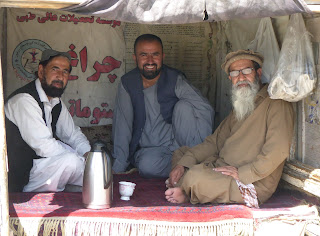
The final leg of our trip took us on to Kandahar - the founding city and spiritual centre of the Taliban. Despite the capital of the country being Kabul, where the government administration is based, Kandahar is the seat of power, as the supreme leader and his spiritual advisers are based there. There we visited a couple of mosques and a mausoleum, and climbed the very steep Forty Steps up to a shrine on a small mountain outcrop. From Kandahar it was on to Ghazni, the capital of the great Ghaznafid empire that ruled the region 1000 years ago.  As with much of the country, it was visited by people such as Alexander the Great and Ibn Battuta, and has been inhabited over the centuries by Zoroastrians, Buddhists, Hindus and Moslems.  The history of this country is really so rich!  The main sight is the two elaborately decorated Ghazni Minarets, built during the period 963–1187 and sadly reduced to half their original 44m height by an earthquake in 1902 - the metal rooves...

and on into the centre of Aghanistan

Image
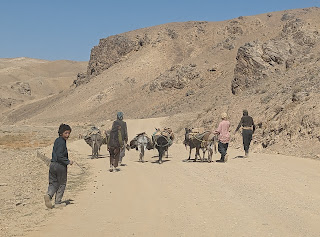
From Bamiyan we set off on an 18-hour drive along unmade roads through the centre of the country, mostly dry and rocky terrain, passing the occasional sheep, goats or donkeys with their accompanying herders but very few other vehicles.  We finally got to the small town of Chagcharan where we spent the night, before continuing the drive along similar roads the next day.  Roads that were not safe to travel on until the Taliban took over and imposd their strong rule over the country.  We went through numerous checkpoints, in some cases just waved through, in others they insisted on seeing our passports and temporary local ID cards, as well as the permission documents carried by our guide.  But eventually we made it to one of the highlights of the trip - the Minaret of Jam. Built around 1190, probably to commemorate the victory of Mu'izz ad-Din (of the Ghorid Empire) over Prithviraj Chauhan, it is believed to be all that is left of the lost city of Turquoise Mountain, wh...

the first few days of my Afghanistan tour

Image
So … I was finally in Afghanistan!!  Covered from head-to-toe in my abaya - thankfully not having to cover my face, but still the abaya was a bit of a pain. Nice not to have to worry about what I wore underneath, or what my hair looked like, but a long garment (down to the ankles) made getting in and out of the back of the vehicle – and even going up and down steps – more difficult, and I couldn’t wear my camera attached to my belt as I usually do, nor access anything in my pockets, and I did miss the feel of the sun on my skin and the wind in my hair…  There weren’t many women on the street (they’re not really supposed to go out without a male guardian), and those we saw were mostly wearing burkas, so there wasn’t really any chance to interact with them.  The men, however, seemed friendly.  Nowhere on the whole trip did I encounter anyone who seemed to be hostile towards us. Kabul is in many respects a modern city – so I chose this picture taken from one of the rock...

preparing for my dream trip

 I’ve wanted to go to Afghanistan ever since I saw some photos of the country in 2003, and having read reports over the past year from a few travellers who’ve enjoyed great visits there since the Taliban took over, I decided it was time to go.  Who knows what will happen going forward, whether access will be closed off once again?  So I signed up for a tour with Untamed Borders, the travel company with the most experience of taking people to the country.  After I signed up and paid my money, the Taliban shut off access for women to the two places in the photos I’d seen back in 2003 (the shrine of Hazrat Ali in Mazar-e Sharif and the lakes of Band-e Amir), but I still wanted to go ahead with it as there are so many other places in the country to see, not to mention the possibility of getting to understand more about the Taliban and the situation in the country. So as instructed by the tour company, I booked my flight to Pakistan and applied for my Pakistan visa – as t...

time out in Bali

Image
Bali is not somewhere I’ve ever felt a need to visit, but it seemed a suitable place to spend a few spare weeks between more important trips.  Ubud - described somewhere as a more 'spiritual' place than the coastal resorts - sounded like somewhere I could rest, and gather my thoughts, without spending too much money. & so it proved to be, in some respects at least.  £4.50 (US$5.75) a night for a comfy bed in a hostel dorm, including breakfast and unlimited water/tea/coffee.  But the karaoke bar next door didn’t help me to rest, and the conversations with other travellers – whilst welcome (and one of the great benefits of staying in hostels) – did not leave me as much time as I expected to gather my thoughts! Nor did the two books in the hostel collection which I read from cover to cover.  But it was a good break. I’m not too sure what I think of Bali.  On the surface it is over-commercialised and far too full of motorbikes.  You can’t walk more than a f...

seeing dragons

Image
  Measuring up to 3 metres and weighing up to 70 kg, the komodo dragon is a super-predator: any creature they can overcome and kill falls within their dietary range, from invertebrates and birds, fellow komodos (when the young hatch they climb straight up a tree, and do not descend until they are strong and fast enough to escape their cannibalistic brethren), the introduced Timor deer, wild boar, water buffalo and goats, and even humans.  The dragons can smell blood and the scent of death from nearly 6 miles away.  They kill by biting their prey, which dies within a few days from the bacteria carried in the Komodo’s saliva, which can cause paralysis, spasms and shock through haemorrhaging.  Animals up to the size of goats are swallowed whole, this process being aided by the komodos' loosely articulated jaws, flexible skull and expandable stomach.  The last human death was in 2009, but a Singaporean tourist who wandered off without a guide was bitten in 2017 (onl...