Posts

a week of tourism around Anatolia
Image
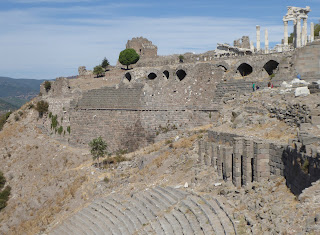
Back from my short 'holiday' in Turkey, which didn't work out quite as planned, but was still worthwhile.  First stop was Bergama, which didn't start well as the bus station turned out to be 6km outside of town, with no local buses that I could see, nor taxis if I had wanted to splurge.  So I walked it.  Not far in normal terms, but when you have a 16kg rucksack on your back, and another smaller but nearly as heavy (with laptop, etc inside) on your front, then it's a long way.  I was exhausted by the time I reached the hotel, although with my room beside a busy road, I still didn't sleep all that well. But the next morning I filled up at the hotel buffet breakfast and set off for the Roman ruins of Pergamum.  6km in the other direction, but at least this time I wasn't carrying all of my luggage!  Not as well-known as some of the other Roman ruins in Turkey, but a great site and with apparently the steepest-sided amphitheatre in the whole of the Roman Empire...

resting in Istanbul

Image
After the excitement of southern Ethiopia, and in anticipation of another couple of organised tours in October and November, I'm now 'resting' in Turkey.  Reminding myself that I'm not really on a 365-day-a-year holiday, but rather taking a more mobile approach to retirement.  & as such, I don't need to be seeing a new 'sight' every single day. Still unsure about my ability to finance this (due to the holiday elements), I'm economising as much as I can during the 'resting' elements.  Which means that I'm staying at the cheapest hostel I could find in Istanbul - £240 for a month including a very basic breakfast (bread with tomato and feta cheese, with tea) - and so living in a dorm with ten other people with whom I also share a bathroom.  There is no kitchen and no socialising area, and the people sharing my dorm - nearly all men since I've been here - are generally not very friendly.  There have been Russians, a Colombian, a Kazahksta...

the other bits of my Ethiopia trip

Image
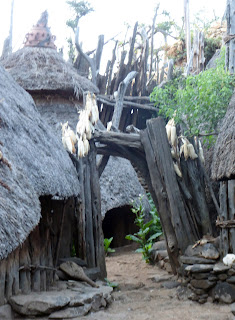
I've already described the highlights (the Mursi lip-plates and the Hamar bull-jumping), but there were other parts to my Ethiopia trip too - meeting people from the Dassanech and Dorze (and seeing where they live), and meeting the King of Konso.  He rules over some 400,000 people, although from his explanations as to his role, he takes rather more of a Queen Elizabeth II approach, talking of 'serving' his people rather than 'ruling' them.  This to the left is his palace. He actually met Prince Charles some years ago, and hadn't heard that the Prince had just a couple of days before become a King! & we met an old Jamaican guy in Sheshamene (the rastafarian town in their 'promised land' of Ethiopia).  This guy had long ago hosted Bob Marley at his place, and he was eager to show us his old balck-and-white photos of the event.  He also told us a little about the Rastafarian beliefs, and shared a copy of a speech that Emperor Haile Selassie had made abo...

the Hamar - coming of age by jumping across a line of bulls

Image
My first introduction to the Hamar was a gentle one, as we visited a small village, shared a beverage and politely took a small morsel each of the goat that was sacrificed in honour of visitors (which we paid for, of course) but which was then shared between the entire village. The next day, however, showcased the other side of the Hamar people - men with painted faces, women with bells and horns, and a young male nervously contemplating his naked leaps over the backs of a row of bulls as the completion of his transition from boy to man. On the way to the ceremony site, we passed some of the men applying the mud paints to their faces, these men being the 'Maza' - men who have successfully jumped the bulls, but who have not yet found a wife and settled down to start a family.  It is their role to help with the ceremony - for example to pull the bulls into line. The ceremony site itself consisted simply of a small flat space partly up a hill, with a couple of small trees and rock...

missing the Queen's death

On the day I was drinking cow's blood with the Mursi, and taking my final photos of the women with (or without) their lip plates, my Queen was dying.  In the late afternoon, which is I believe when the message was released that her doctors were concerned about her health, I was watching a small Hamar community sacrifice and cook a goat in our honour.  If I'd been in London and heard that message, I probably would have joined the throng outside Buckingham Palace, but I was oblivious to what was going on. That night was the first of two in a campsite in the Omo Valley area, right down in the south of Ethiopia, so not somewhere that gave me any access to wifi.  However we'd had a group conversation earlier in the trip where I'd noted my addiction to the news, that for example the first page I open in the morning when I go online is the news - to check that nothing major has happened in the world "like an earthquake, assassination, or the Queen dying", so when the...

the Mursi - lip plates, blood and scars

Image
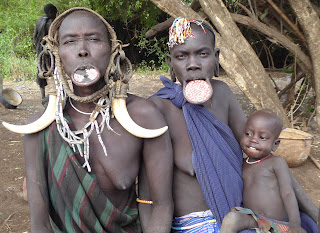
I've long dreamed of seeing the Mursi tribe of Ethiopia's Omo Valley, although have been warned that it has become a human zoo, with any visitors surrounded by lip plate-wearing women demanding money for photos.  But I still wanted to go - wanted to see these women with my own eyes - to see a tradition that will surely disappear before long. As I made the long journey down to the Omo Valley, with a tour organised by a Spanish company (Last Places) that like to go a little deeper into the cultures of the tribes they visit, it was clear that only a limited number of people would make such a journey.  Whilst only some 500km from the capital, I believe, it is a journey of two long days' driving, much of it unsurfaced dirt tracks, all of it slowed considerably by the flocks of cows and goats being herded along those roads, the donkey carts, and indeed the random goats who have just decided that the road is a comfortable place to take a rest and who are not going to move just bec...

less conventional tourism in the Lebanon

Image
Well, perhaps all of the tourists who come here visit Hezbollah's Museum of the Resistance, but just don't write about it because, well, this Lebanese Shia Islamist political party and militant group are classified as international terrorists by much of the West including the US, UK and EU (and due to this, I'm not including the photo I want to of one of their campaign posters with their flag in it ... who knows which surveillance systems might see and recognise it). First, a bit of background - for myself as much as for anyone else reading this.  Under a 1943 agreement, political power is divided among Lebanon’s predominant religious groups - a Sunni Muslim serves as Prime Minister, a Maronite Christian as President, and a Shiite Muslim as the speaker of parliament. Tensions between these groups evolved into civil war, however, as several factors upset the balance, especially the arrival of the Sunni Muslim Palestinian refugees in 1982, when they were expelled from Jordan....